

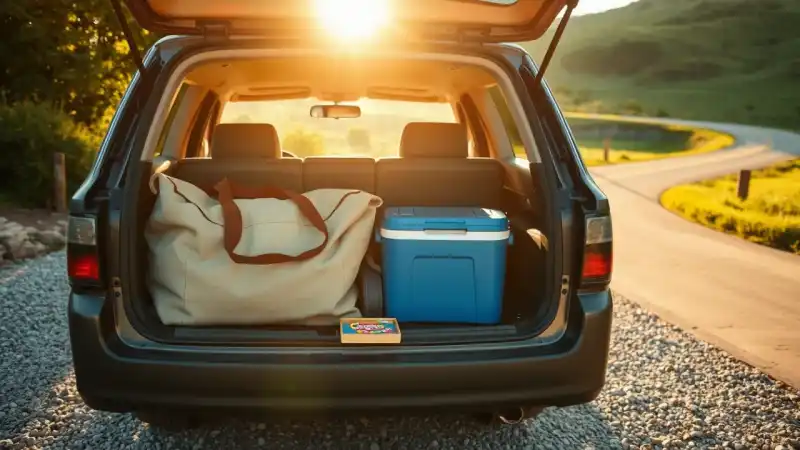
The best road trip ideas for kids pair short driving days with a rotating mix of activities: talking games like I Spy and the license plate game, audiobooks, a bag of small new toys, plenty of snacks and planned stops every few hours. What works depends mostly on your child’s age. Toddlers need hands-on toys, while tweens do better with real jobs like navigator or DJ.
Destination matters less than pacing. A modest drive to a lake or a national park, with room for breaks, usually goes better than an ambitious route that keeps everyone buckled from breakfast to bedtime.
How to keep kids entertained on a road trip
The simplest way to keep kids entertained on a road trip is to rotate activities instead of handing everything over at once. Release one new thing at a time, such as a game, a snack or a toy, and save screens for the hardest stretch of the day. A tired 4-year-old at hour five needs something fresh, and you can’t provide that if the whole bag is already open.
A few approaches help on almost any drive:
- Start with nothing. Give kids the first stretch to look out the window, notice things and talk. Boredom often turns into observation, questions and made-up games.
- Use a surprise bag. Wrap small, cheap items like stickers, a mini puzzle or a new crayon set, and hand one out at each state line, each stop or each hour.
- Give everyone a job. Kids can spot exit signs, count cows, pick the next song or announce the miles left. A role makes the drive feel like their trip too.
- Schedule screen time. Downloaded shows or movies work best as a planned block, for example after lunch, rather than as an emergency fix. Download everything before you leave, since signal drops on rural highways.
- Plan stops worth stopping for. A playground, a roadside attraction or a visitor center burns energy far better than a gas station.
Screen-free car games and activities kids actually like
Screen-free car games need no supplies and work for a wide range of ages, so they suit families with siblings of different ages. Keep a few in your back pocket and switch when interest fades.
- I Spy. One person picks something visible and gives a color or first-letter clue. For toddlers, use colors only.
- License plate game. Spot plates from as many states as you can. Print a US map beforehand so kids can color in each state.
- Alphabet game. Find letters A through Z, in order, on signs, trucks and billboards.
- 20 Questions. One person thinks of an animal, person or object, and everyone else asks yes-or-no questions to guess it.
- Story chain. Each person adds one sentence to a shared story. Silly turns are encouraged.
- Would You Rather. Funny either-or questions get even quiet kids talking.
- Road trip bingo. Printable cards with cows, bridges, red trucks and water towers keep pre-readers engaged.
- Audiobooks and family podcasts. A long chapter book can carry a family through hours of highway, and everyone hears the same story.
- Car karaoke or a family playlist. Let each person add songs before you leave and take turns choosing.
Geography and nature games pay off once you arrive. Card and board games such as Trekking the National Parks, Ticket to Ride or the Wild Kratts Around the World Game are better saved for the hotel or campsite table than the back seat. A paper atlas or a kids’ map activity book lets children trace the route as you go.
Road trip activities by age
Road trip activities work best when they match a child’s attention span and skills. The table below gives a starting point. Many families mix columns when siblings are close in age.
| Age | Activities that work | What to skip |
|---|---|---|
| Toddlers (1–3) | Board books, magnetic drawing boards, simple noise-making toys, finger puppets, color-only I Spy, songs | Small pieces, loose crayons that roll away, anything hard enough to hurt if thrown |
| Preschool (3–5) | Sticker books, water-reveal coloring pads, road trip bingo, short audiobooks, surprise bag | Reading-heavy games, long movies |
| Early grade school (6–8) | License plate game, 20 Questions, travel journals, joke books, chapter audiobooks, map tracing | Close reading if they get carsick |
| Tweens (9–12) | Navigator role, playlist DJ, trip budget for snacks, camera or photo challenge, logic puzzles, longer audiobooks | Activities that feel babyish, rules with no input from them |
| Teens (13+) | Planning a stop or two, music and podcast picks, photo projects, headphones and downtime | Over-scheduling every minute |
Fun road trip activities for a 7-year-old
A 7-year-old can usually read simple signs, follow game rules and enjoy small responsibilities, so this age is a good one for a trip “job.” Try a travel journal where your child draws one thing from each day, a scavenger hunt list (“a horse, a tunnel, a yellow car”), the alphabet game, joke books read aloud, and a chapter audiobook. Giving a 7-year-old a printed map and a marker to track progress also cuts down on “Are we there yet?”
Road trip activities for 12-year-olds
Road trip activities for 12-year-olds work best when they offer independence. Hand over the navigation app (with you double-checking), a set snack budget for each stop, or the task of picking one restaurant or attraction per day. Photo challenges, such as the best sunset or the weirdest sign, keep a phone pointed out the window instead of at a feed.
Must-haves for a road trip with kids
The must-haves for a road trip with kids fall into four groups: safety, comfort, food and cleanup. Pack a small bag for each child within reach and keep the rest in the trunk.
- Correct car seats or boosters. Check the fit before the trip, especially if a child has grown since the last long drive.
- Snacks and refillable water bottles. Choose low-mess foods like crackers, cheese sticks, fruit and pretzels, and pack extra.
- Cleanup kit. Wipes, paper towels, plastic bags, a spare change of clothes per child and a roll of trash bags.
- Motion sickness supplies. Pack bags, mints or crackers and an old towel. Ask your pediatrician before giving any motion sickness medicine.
- Comfort items. A small pillow, a blanket, a favorite stuffed animal and sunshades for side windows.
- Entertainment bag. Books, coloring supplies, a magnetic drawing board, the surprise bag and headphones for each child.
- Tech backups. Car charger, extra cables, downloaded shows and audiobooks, and a paper map for dead zones.
- Basic first aid. Bandages, any prescription medicines, sunscreen, bug spray and your children’s medical information.
- Portable potty or a training-potty seat for toddlers in the middle of potty training.
What is the 3-3-3 rule for a road trip?
The 3-3-3 rule for a road trip is a pacing guideline: drive no more than 300 miles a day, arrive at your stop by 3 p.m., and stay at least 3 nights in a place before moving on. The rule started among RV travelers, but it suits families with kids because it builds in daylight, downtime and fewer pack-up mornings.
With kids, the 3-3-3 rule usually needs one adjustment: more breaks. Young children may need a stop every couple of hours for bathrooms, food and running around. Arriving by mid-afternoon also leaves time for a swim in the hotel pool before dinner, which can matter more to a 6-year-old than the scenery.
A worked example
Say you plan a 900-mile drive with a 4-year-old and an 8-year-old. Under the 3-3-3 rule, that becomes three driving days of about 300 miles each, rather than one exhausting push. Leave after breakfast, take a mid-morning playground stop and a lunch stop, and reach the hotel by 3 p.m. The total trip is longer, but each day is manageable, and kids arrive with energy left for the destination.
Car seat safety on long drives
Car seat rules matter more on a road trip because kids spend hours in the seat, often while asleep. The American Academy of Pediatrics and the National Highway Traffic Safety Administration recommend keeping children rear-facing as long as their seat allows, then forward-facing with a harness, then in a booster until the adult seat belt fits properly. A proper fit usually comes when a child is about 4 feet 9 inches tall, often between 8 and 12 years old. Children under 13 should ride in the back seat.
- Check your state’s law. Car seat and booster requirements vary by state, and you must follow the law in each state you drive through.
- Skip puffy coats in the seat. Bulky coats can keep harness straps from fitting snugly. Buckle in first, then lay a blanket or the coat on top.
- Keep loose items soft. Heavy toys, tablets and drinks can fly forward in a sudden stop. Stash hard items in seat-back organizers or the trunk.
- Don’t extend car seat sleep after the drive. When you stop for the night, move babies to a flat, firm sleep surface rather than leaving them in the car seat.
- Get a free fit check. Certified child passenger safety technicians can inspect your installation, and many fire stations, hospitals and local safety groups offer checks.
Family road trip ideas: kid-friendly US destinations
Family road trip destinations with short hikes, wildlife and hands-on activities tend to hold kids’ interest best. National parks are a reliable choice because ranger programs and visitor centers are built for families. These routes give a range of regions and trip lengths.
| Destination | Region | Why kids like it | Good for |
|---|---|---|---|
| Great Smoky Mountains and Gatlinburg | Tennessee and North Carolina | Easy waterfall hikes, wildlife spotting, attractions in town | Weekend or week-long trips from the East and South |
| Black Hills and Badlands | South Dakota | Mount Rushmore, wild bison, otherworldly rock formations | Week-long loop from the Midwest |
| Olympic National Park | Washington | Tide pools, rainforest trails, mountain views | Pacific Northwest families |
| Colorado mountain towns | Colorado | Rafting, hiking, hot-air balloons, river kayaking | Summer adventure trips |
| Florida Keys | Florida | Beaches, snorkeling, and a ferry or seaplane option from Key West to Dry Tortugas National Park | Winter and spring breaks |
For a weekend road trip with kids, pick a destination within a few hours’ drive. A state park with a beach or playground, a children’s museum in a nearby city, or a farm with seasonal activities can feel like a big adventure without a long haul.
Common mistakes on road trips with kids
Common road trip mistakes with kids usually come down to overplanning the drive and underplanning the breaks.
- Driving too far in one day. Long days lead to meltdowns for kids and adults alike.
- Opening the activity bag at mile one. Spread new things across the whole drive.
- Relying on streaming. Rural cell coverage is spotty, so download content ahead of time.
- Sugary snacks before naps. Save treats for the end of the day or for after a stop.
- Skipping kids’ input. Let each child choose one stop or activity, and complaints often drop.
FAQ
– What are some road trip ideas for kids on a budget?
Budget road trip ideas for kids include packing all snacks and most meals, choosing state and national parks, and staying in hotels with free breakfast or in campgrounds. An annual America the Beautiful pass covers entrance fees at national parks and many federal lands. The Every Kid Outdoors program has offered fourth graders a free pass, so check its current status before you go.
– What is a good age for a first long road trip?
Any age can work for a first long road trip, as long as you plan around naps, feeding and stops. Babies who sleep well in the car can be easier than active toddlers. Many families find road trips get easier once kids can enjoy audiobooks and simple car games.
– Is it better to drive at night with kids?
Driving at night with kids can work if children sleep easily in the car and the driver is well rested. Drowsy driving is a real danger, so switch drivers or stop if you feel tired. Many families prefer an early start after a full night’s sleep instead.
– How do you prevent carsickness on a road trip?
Carsickness on a road trip is easier to prevent when kids look out the front or side windows, avoid reading or screens on winding roads, and get fresh air. Light, plain snacks help more than heavy or greasy meals. If your child gets carsick often, talk to your pediatrician before the trip about options.